Why the question gets dismissed
Ask most people whether plumbing freezes in this part of Arizona and the answer will be no, usually with some amusement. That answer is right about the thing they are picturing and wrong about the thing that actually happens.
Interior plumbing inside a heated building is genuinely not at risk here. Nobody needs to worry about pipes in the walls of an occupied house.
But Cave Creek sits in the Sonoran Desert foothills at elevation, roughly thirty miles from downtown Phoenix and noticeably higher. Clear desert skies radiate heat away efficiently overnight, so the gap between a pleasant afternoon and a pre-dawn low is larger here than the daytime forecast suggests. A winter day in the sixties can precede a morning at or below freezing.
And the properties in this area carry an unusual amount of plumbing outside the building envelope. That combination, not the weather alone, is what produces the calls.
What these properties have that a suburb does not
The rural, large-lot, equestrian character of this area shapes the risk directly. Housing here skews custom builds on acreage rather than tract homes on quarter-acre plots, and that changes what plumbing exists and where it runs.
Drip irrigation is close to universal on desert landscaping, with valves, manifolds and long runs of line, much of it shallow or above ground. Horse properties have troughs and their supply lines. Outdoor showers, water features and outdoor kitchen connections are common. So are long supply runs out to detached garages, workshops, barns and well houses.
Every one of those is a length of pipe exposed to overnight cold and, for the rest of the year, to intense sun that degrades plastic over time. A UV-embrittled irrigation line splits far more readily on a cold night than a new one does.
Pump and pressure tank enclosures deserve their own mention. On the many properties here running from a private well, that equipment sits in an unheated structure, and the fittings around a pressure tank are exactly the kind of small-bore, water-filled components that suffer first.
What freezing actually does
Why the split appears after the thaw, not during the freeze
It is worth understanding the mechanism, because it explains why damage often shows up somewhere other than where the ice formed, and why it frequently appears hours after the thaw.
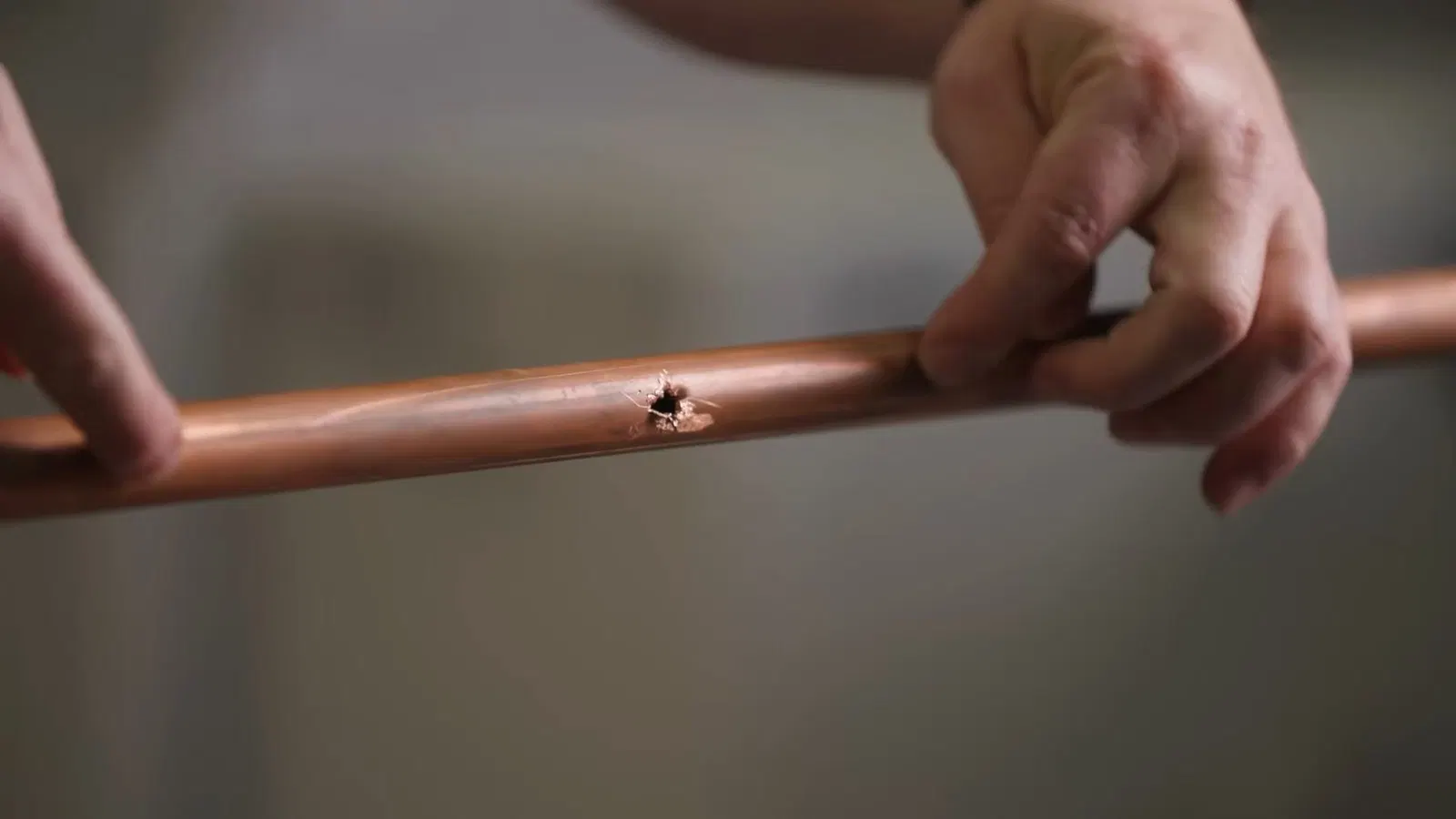
Water expands as it freezes. In an open system that expansion has somewhere to go. In a closed length of pipe with a valve at one end, it does not, and pressure builds ahead of the advancing ice rather than at the ice itself.
That trapped pressure is what splits the pipe, which is why the failure point is often at a fitting, a valve body or a thinner section some distance from the coldest spot. It is also why the split does not leak while everything is still frozen. Ice plugs the hole.
So the classic sequence is a cold night, a quiet morning where everything seems fine, then water appearing an hour after the sun comes up as the plug thaws. People conclude the problem happened at midday. It happened at four in the morning.
The practical implication is worth acting on: after a hard freeze, check your outdoor fixtures and irrigation zones after things have warmed up, not while it is still cold.
STUCK ON THIS ONE?
An insulated cover costs very little against a buried irrigation repair. Call (480) 806-2944 and you will get a range and an arrival window before anyone is dispatched.
What prevents it, in order of value for money
| Measure | Protects | Effort |
|---|---|---|
| Insulated hose bib covers | Outdoor taps on exterior walls | Minutes, and they last years |
| Disconnect hoses before winter | The bib and the pipe behind it | None, and leaving hoses on defeats the cover |
| Drain and shut off irrigation zones | Valves, manifolds and shallow line | An afternoon once a season |
| Pipe insulation on exposed runs | Runs to outbuildings and pump houses | An hour or two, materials are inexpensive |
| Insulate the pump and pressure tank enclosure | The most expensive components outdoors | Half a day, done once |
| Know where your shutoffs are and test them | Everything, by limiting what a failure costs | Ten minutes |
The hose row is the one people skip and it undoes the row above it. A hose left connected keeps water in the bib and prevents it draining, so the cover is insulating a pipe that is still full. Disconnecting costs nothing.
The last row is the highest value item on the list and has nothing to do with insulation. A shutoff you can find and that actually closes is the difference between a split line and a flooded property. In water this hard, valves that have sat untouched for years accumulate deposit around the stem and frequently will not close fully when it matters. Test yours on an ordinary afternoon rather than discovering it during an emergency.
If it has already split
- Close the main shutoff. On a well or storage tank system, cut power to the pump as well, because a pump keeps pushing water through a break until it is switched off.
- Open a low fixture to drain pressure out of the system once the supply is closed.
- If you cannot reach the main, close the nearest isolating valve upstream of the break instead.
- Cut power to any circuit where water is spreading. Electricity before plumbing.
- Photograph the scene before moving or cleaning anything.
- A repair clamp or tape on an accessible pipe is a stopgap once the water is off, not a repair.
A split on an exposed outdoor line after a freeze is an event with an obvious external cause, and there is nothing to infer about the plumbing indoors. It is a repair and that is the end of it.
A pinhole on an interior copper run is a different message entirely, because it is the visible end of a process happening along the whole run. Do not let the two get counted together when you are weighing whether the system as a whole is telling you something. One is exposure; the other is condition.
And if water reached flooring, drywall or cabinetry, that is a separate clock from the plumbing repair. Drying runs on its own dispatch line so both can move at once rather than in sequence.
Cold weather plumbing questions locally
How cold does it have to get before I should worry?
Sustained hours below freezing matter more than the low itself. A brief dip just below at dawn is less risky than a night that sits below freezing for several hours.
The practical trigger is a forecast overnight low at or under freezing. That is the evening to disconnect hoses and check covers, and it happens more often here than most people expect.
Should I leave a tap dripping overnight?
It is a reasonable measure for genuinely at-risk exposed runs, because moving water is harder to freeze and a dripping tap relieves the pressure build that actually splits pipe.
On a property drawing from a storage cistern or a low-yield well, weigh it against the water it uses. Insulation and draining are usually the better answer there.
My irrigation line split. Is that a plumbing job?
It can be either, and it depends where. Line downstream of the irrigation valves is usually irrigation work. A split at the supply connection, the backflow device or the bib feeding the system is plumbing.
If the loss is somewhere on a buried run and you cannot see it, that becomes a locating job first. Dry ground here absorbs a slow leak with very little to show at the surface.
Do I need to insulate pipes inside the house?
Inside a heated building, no. In unheated spaces attached to it, sometimes: an unheated garage, a shed, or a pump enclosure all behave like outdoors.
The pump and pressure tank enclosure is the one worth attention on a well property, because the components in there are among the more expensive things outdoors.
Why did the leak appear hours after it warmed up?
Because ice was plugging the split. Water expanding as it freezes builds pressure ahead of the ice and cracks the pipe, but nothing escapes while the plug is still there.
As it thaws the plug clears and the split starts leaking. That is why checking outdoor fixtures after a hard freeze should happen once things have warmed, not during the cold.
Is a cracked hose bib expensive to fix?
On its own, no. It is an accessible fixture and a straightforward replacement, particularly if the split is at the bib rather than in the wall behind it.
What raises the cost is not noticing. A bib that splits inside the wall line, or an irrigation break on a buried run, can lose water for a long time before anyone sees it, and in dry ground there is often nothing at the surface to notice.