Pipes and repiping
Repiping in Cave Creek, AZ
Nobody repipes a house on a whim. It becomes the right answer when the pattern of failures stops looking like bad luck and starts looking like a system.
The pattern that means it is time
A single pinhole leak on a copper line is an event. A second one on the same system eighteen months later, in a different place, is information. By the third, the question has stopped being whether to repair and started being how many more repairs you are prepared to buy.
The mechanism behind that pattern is specific and worth understanding, because it explains why failures cluster in time rather than spreading evenly over decades. Very hard water deposits mineral inside copper continuously, and it deposits unevenly. Corrosion concentrates at the boundaries between scaled and bare metal, so the pipe does not thin uniformly toward a predictable end of life. It develops localised weak points.
Those weak points develop across the whole system at roughly the same rate, because the whole system was installed at the same time and has carried the same water ever since. So when one fails, the others are typically not far behind. That is why the interval between the first and second leak is usually longer than between the second and third.
Repiping is the decision to stop paying for that sequence one opening at a time.
Running the comparison honestly
| Repair as you go | Repipe | |
|---|---|---|
| Cost on the day | Low per event | The largest plumbing bill most owners see |
| Cost over five years | Unpredictable, and rising as failures cluster | Fixed, known at the outset |
| Disruption | Repeated, unscheduled, often at bad times | One planned period, typically several days |
| Collateral damage | Each failure risks flooring, drywall and contents | Controlled openings in chosen places |
| Suitability | Sensible while failures are genuinely isolated | Sensible once they are not |
The comparison that actually matters
The column people compare is the first row, and that is the wrong comparison. One repair is obviously cheaper than a repipe. The relevant question is what the next five years cost under each approach.
The row that decides it for most households is collateral damage. A repair is planned; a failure is not. A pinhole behind a wall or under a slab that runs overnight brings a drying and reinstatement job with it, and that is frequently the larger of the two bills.
Where the failures have been under a slab specifically, rerouting away from under the concrete is often part of the repiping plan rather than a separate decision.
TALK IT THROUGH FIRST
Two pinholes in eighteen months is a pattern worth pricing properly. Call (480) 806-2944 and describe what you are seeing; you will get a range and a window before anyone is dispatched.
What the work involves, and how disruptive it really is
A repipe replaces the distribution system: the runs carrying water to the fixtures. It does not usually mean replacing the drain and waste lines, which are a separate system with a separate lifespan, or the service line from the meter or pump.
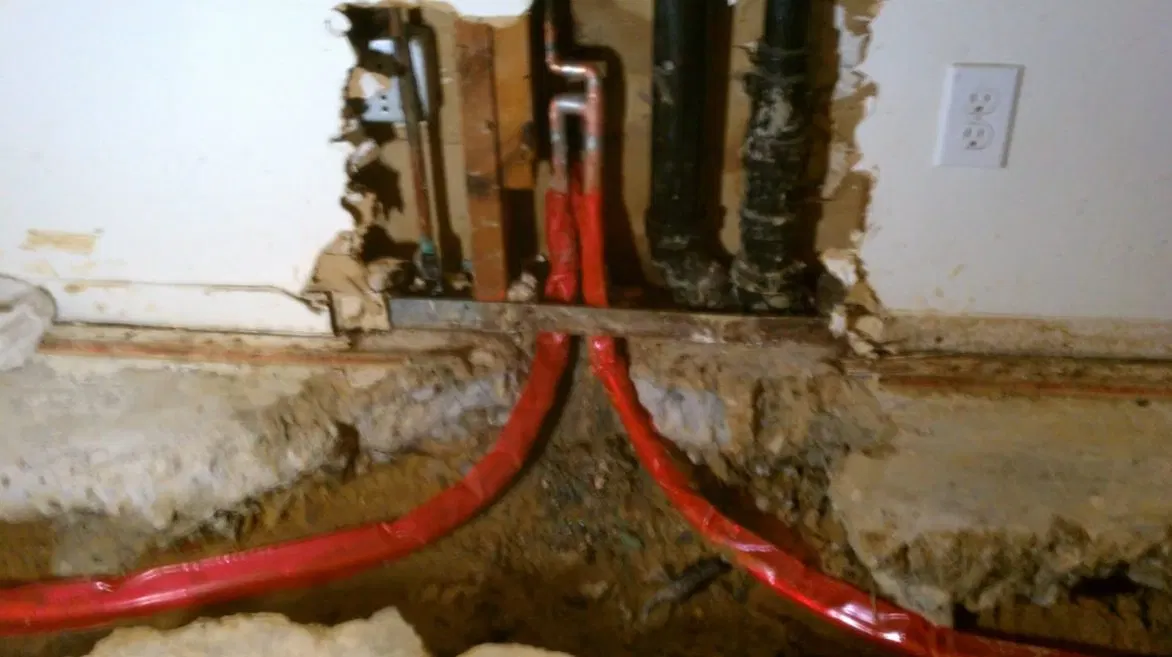
Modern repipes are generally routed through walls, ceilings and attic spaces rather than back under the slab. That is deliberate. It removes the buried runs from the equation entirely, so a future failure is accessible rather than requiring the floor to come up, and it makes the work far less invasive than people picture.
In practice the visible disruption is a set of controlled openings in drywall at planned locations, most of them small, plus the fixture connections. Water is off for parts of the process rather than throughout, and most households stay in the property.
The reinstatement is a real part of the cost and worth having quoted explicitly. Patching and repainting drywall is straightforward. Matching a textured finish, tile or a decorative wall treatment is where estimates diverge, so it is better discussed at quotation stage than discovered afterward.
Doing it once, and not repeating the cause
Five things worth settling up front
- Agree the routing before work starts, including where openings will be made and what the reinstatement covers.
- Take photographs of the runs before the walls close, since knowing where the pipe actually goes is worth a great deal later.
- Replace fixture shutoff valves at the same time. They are accessible exactly once and old ones frequently no longer close.
- Confirm permitting, which goes to the Town of Cave Creek inside town limits and to Maricopa County Planning and Development for unincorporated parcels.
- Fit water treatment as part of the project rather than after it.
That final point is the one that determines whether the new system has a better life than the old one. Repiping without addressing the water means installing new pipe into exactly the conditions that consumed the last set.
Modern materials are more tolerant of hard water than the copper they usually replace, so the outcome will be better regardless. But reducing what the water deposits protects the fixtures, valves and water heater at the same time, and those are the components that will otherwise keep generating calls.
Permits, inspections and which edition you are building to
CODES AND PERMITS
A repipe is permitted work, and the inspection is genuinely useful rather than a formality: it puts an independent set of eyes on materials, routing and support before the walls close. Where the permit goes depends on the address. The Town of Cave Creek runs its own building department and adopts the International Plumbing Code (IPC) by reference in its municipal code. Unincorporated parcels go to Maricopa County Planning and Development, which enforces the 2018 IPC under its Local Additions and Addenda.
Because Arizona leaves plumbing code adoption to cities and counties rather than setting a state standard, neighbouring jurisdictions here are genuinely on different editions. Confirm which applies before the work is specified, and expect your contractor to know it. Licensing throughout the state runs through the Arizona Registrar of Contractors.
Repiping questions homeowners ask here
How do I know it is time rather than just unlucky?
Count the failures and their spacing. One leak is an event. Two in a couple of years in different locations is a pattern. Three is a system telling you something.
Other signals: pipe of a known problematic material or age throughout, visible corrosion at accessible joints, discoloured water at multiple fixtures, or pressure that has fallen across the whole house rather than at one tap.
Do you have to replace everything, or can it be partial?
Partial repipes are legitimate where the failures are confined to an identifiable section, for example one run or one wing of a house.
The caution is that leaving original pipe in place leaves the original problem in place, and the boundary between new and old becomes the next thing to watch. It is a reasonable choice with clear eyes about what it does and does not solve.
How long does a repipe take?
For a typical house, several days rather than weeks. Larger properties and complex routing take longer.
Most of the schedule is access and reinstatement rather than pipe work. On the large custom homes common around here, unusual routing and long runs to detached structures can extend it, which is why a walk-through before quoting matters.
Will I have to move out?
Usually not. Water is shut off for portions of the work rather than continuously, and the working areas are generally confined to the routes and fixture locations.
It is disruptive in the sense that there is dust and there are people in the house. It is not usually disruptive in the sense of being uninhabitable.
Does repiping fix my water pressure?
Sometimes, and it depends on the cause. If pressure has dropped because scale has narrowed the bore of the supply runs, then yes, new full-bore pipe restores it.
If the cause is upstream, a supply-side restriction, a pressure regulator, or on a well property a pressure tank that has lost its air charge, then repiping will not change it. Establishing which before committing to the work matters.
Should I repipe before selling?
That is a commercial judgement rather than a plumbing one, and it depends on your market and what disclosure requires.
What is worth knowing is that a documented history of repeated leaks on original pipe is information a buyer's inspection may surface anyway, and it is easier to discuss with a completed repipe than with a pattern of patches.
Second or third leak in the same house?
Describe the failures and roughly when each happened. The pattern tells you more about whether repiping is warranted than any single leak does.