How a faucet actually stops water
A faucet is a simple idea executed precisely. Two smooth surfaces are pressed together tightly enough that water cannot pass between them. Turn the handle and they move apart. That is the whole mechanism, whether it is a ceramic disc cartridge, a ball valve or an older compression design.
Everything about a faucet's reliability depends on those surfaces staying smooth. They are machined to tolerances where a scratch you could barely feel is enough to let water through, which is why a dripping faucet cannot be fixed by turning it harder. Force presses damaged surfaces together more firmly without making them match.
This matters because it tells you what a faucet is vulnerable to. Not pressure, not temperature, not normal use. Grit.
What very hard water does to those surfaces
Mineral between two sealing surfaces is sandpaper
Water in this area is very hard, widely reported in the mid to high teens in grains per gallon, against a threshold of about ten where the industry starts calling water very hard.
Dissolved calcium and magnesium come out of solution wherever conditions favour it, and the inside of a valve is full of such conditions: temperature changes, pressure changes, and surfaces to nucleate on. Mineral precipitates onto valve seats, cartridge bodies and the O-rings that seal them.
Once there is hard particulate between two precision sealing surfaces, every operation of the handle grinds it into them. It is a lapping process, and it works exactly as well as lapping is supposed to, which is to say it removes material.

So the cartridge that would have lasted a decade somewhere with soft water gets scored in a fraction of that time here. Once scored, it drips, and no amount of cleaning restores a surface that has material removed from it. That is why a replacement faucet fitted into the same conditions is on the same trajectory from the day it goes in.
STUCK ON THIS ONE?
If several fixtures are failing at once, the fixtures are not the problem. Call (480) 806-2944 and you will get a range and an arrival window before anyone is dispatched.
Three complaints, three different causes
| Complaint | Actual cause | The fix |
|---|---|---|
| Drips from the spout when closed | Scored cartridge or valve seat | Replace the cartridge or seats, not the faucet |
| Handle has become stiff | Deposit in the cartridge's moving parts | Cartridge replacement; do not force it |
| Weak or spraying flow at one tap | Scaled aerator | Unscrew, soak in vinegar, refit. Costs nothing |
| Leaks around the base of the spout | Failed O-ring under the spout collar | O-ring replacement, a genuine repair |
| Water in the cabinet below | Supply connection, shutoff, or the drain assembly | Needs looking at promptly; cabinet bases absorb water |
| Weak flow at every tap | Supply, pressure, or pressure tank | Not a fixture job at all |
The aerator row is the single most commonly missed cheap fix in plumbing. It is a small screen at the spout tip, it scales up steadily in this water, and unscrewing it takes seconds. People replace entire faucets over what a vinegar soak would have resolved.
The bottom row is the one that changes the whole visit. Several fixtures losing pressure at once is never a faucet problem, and replacing faucets will not touch it. On the town supply it can mean a restriction or a loss on the line. On the many properties here running from a well or a storage tank, it more often means a pressure tank that has lost its air charge or a booster pump struggling. Say so when you call, because it points the diagnosis somewhere completely different before anyone leaves.
What to check before assuming the fixture is finished
- Take the aerator off and look at it. If it is furred with white deposit, that alone may be your flow problem.
- Establish whether the drip is from the spout, which is a cartridge issue, or from the base, which is an O-ring.
- Open the cabinet and feel the base panel, not just look at it. Particleboard absorbs water and darkens late.
- Test the shutoff valves under the sink by closing them. Old stops in hard water frequently will not close fully, and finding that out during an emergency is the wrong time.
- Count how many fixtures are affected. One is local; several is upstream.
- Check whether the faucet brand still supplies cartridges for that model, because that decides repair against replacement more often than condition does.
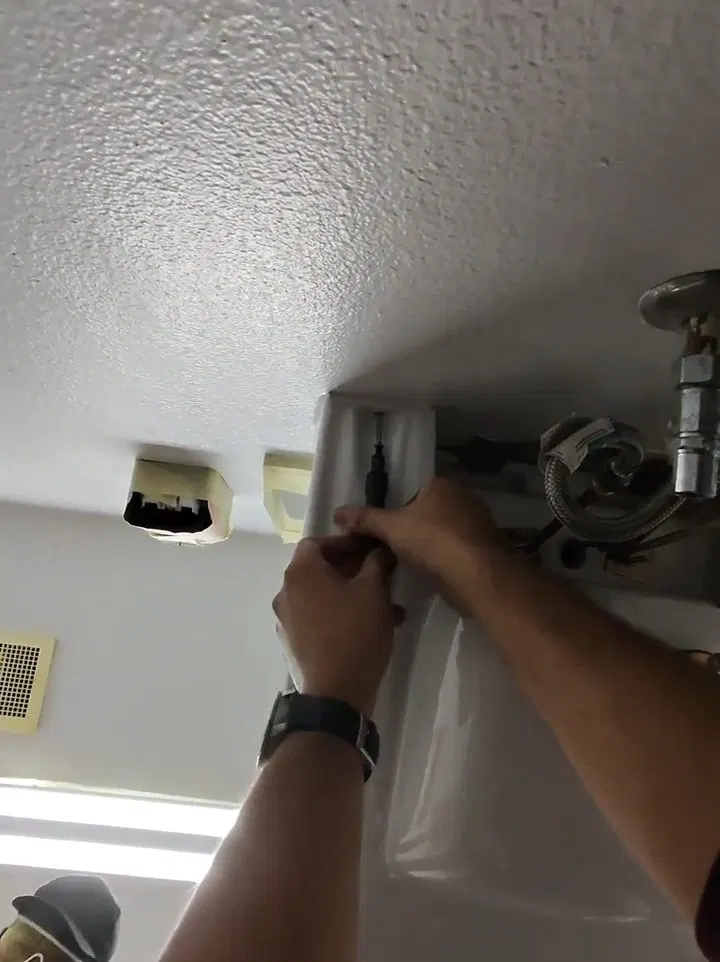
That last point is worth taking seriously when buying as well as when repairing. A faucet whose parts cannot be sourced becomes a full replacement the first time it drips, which in this water will not be far away. That makes parts availability a more useful purchase criterion here than finish or styling, and it is a false economy to ignore at any price point.
Doing something about the cause rather than the symptom
If you are replacing cartridges, seats and aerators repeatedly across the house, the fixtures are not failing. They are reporting on the water, and each replacement buys another turn of the same cycle.
The practical argument for treatment is not really about how the water feels in the shower, though that is the part people notice. It is that reducing dissolved hardness changes the operating conditions for every sealing surface, valve, cartridge and appliance in the building at once. Compared with fixing one fixture at a time, that is a much better return, and the water heater benefits most of all.
Where the concern is what is in the water rather than how hard it is, which is a genuinely open question on the properties around here running from private wells or hauled deliveries, then testing before specifying anything is the sensible first step. The two are different problems with different equipment, and buying one expecting the other's benefit is a common and expensive mix-up.
None of this makes a dripping faucet urgent. It makes it a symptom worth reading rather than just silencing.
What people ask after the third cartridge
Is a dripping tap actually worth fixing?
On a metered municipal connection the water cost usually justifies it in reasonable time, and constant flow also wears the fixture and the drain.
On a property drawing from a storage cistern or a low-yield well, the argument is much stronger. There is no bill to alert you, and a continuous drip is a measurable fraction of a tank between deliveries.
Can I descale a faucet myself?
The aerator, absolutely, and it is worth doing. Unscrew it, soak it in vinegar, rinse and refit.
Cartridge internals are less forgiving. Once sealing surfaces are scored, cleaning does not restore the seal, and partial disassembly of a stiff faucet often ends with a broken handle or a stripped fitting.
Will a more expensive faucet last longer here?
Somewhat, and mostly for one reason: better fixtures tend to have serviceable cartridges that are actually available years later.
The mechanism that wears them is the same regardless of price. A premium faucet on untreated very hard water still gets grit between its sealing surfaces; it is just more economical to repair when it does.
My outdoor faucet drips constantly. Same thing?
Similar mechanism, harsher conditions. Outdoor fixtures take sun, temperature swings and winter cold on top of the same mineral wear.
They matter more here than people assume, because properties on these parcels tend to have extensive outdoor plumbing: irrigation, troughs, outdoor showers and long runs to detached structures. Outdoor runs are consistently over-represented in leak calls.
Should I replace the shutoff valves at the same time?
Generally yes, and it is one of the better small decisions available. Old stops in this water accumulate deposit around the stem and seat and often will not close fully.
They are accessible exactly once, while the cabinet is already open, and the cost is small. It is the difference between isolating a future problem at the fixture or at the main.
Do you fit faucets I buy myself?
Generally yes. Check hole spacing and whether it suits the existing deck before buying, and check that replacement cartridges are genuinely available for that model.
That last check matters more here than the purchase price does, for reasons the rest of this article covers.