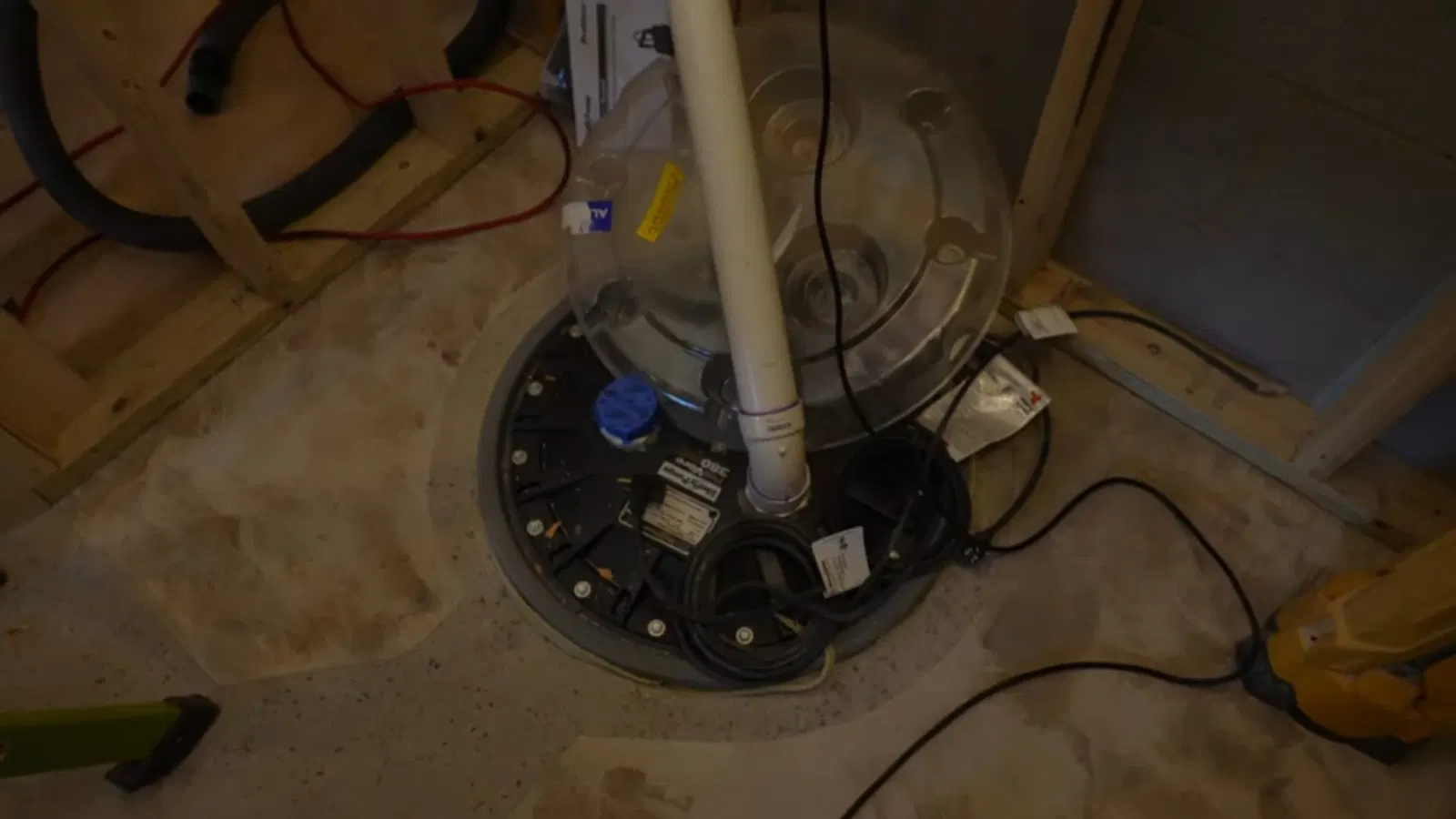
Why the standard advice does not work here
Search for how to find a water leak and you will get the same first step every time. Turn everything off, read the meter, wait an hour, read it again. If the number moved, water is leaving your system.
It is good advice. It is also written for someone on a municipal connection with a meter in a box near the street, and that is not the whole picture in this part of Maricopa County. The Town of Cave Creek runs a metered municipal system supplied almost entirely by Colorado River water through the Central Arizona Project, treated at the plant on Basin Road. But the town boundary and the water service boundary are not the same shape, and plenty of parcels sit outside it.
Those properties draw from a private well. Some buffer a low-yield well with an above-ground storage cistern, commonly somewhere between 2,500 and 10,000 gallons. Some have no well at all and run entirely on water hauled in by truck and pumped into a tank.
None of them have a meter. So the single cheapest, most objective leak detection method available to a homeowner simply does not exist for them, and the consequence is that leaks on these properties run undetected for far longer. There is no monthly bill arriving with a number on it that looks wrong.
The three signals that replace the meter
You are not without evidence. You have three signals, and between them they do most of what a meter would do.
- Delivery frequency. If you are ordering water more often than you used to with no change in the household, that is your bill spiking. Treat it the same way.
- Pump behaviour. A submersible or booster pump that starts when nothing in the house is drawing water is telling you water is moving. That is the closest equivalent to a creeping meter dial.
- Tank level over a fixed period. A measured drop overnight with nothing running is direct evidence, and unlike the other two it gives you a rough rate.
The third one is worth doing properly rather than eyeballing. Mark the level at night, close the valve to the house, and read it again in the morning. If it dropped with the house isolated, the loss is between the tank and that valve. If it held overnight but drops during normal use faster than it should, the loss is inside the building or on a run downstream of the isolation point.
That single test splits the property in half, which is most of the diagnostic value a meter provides.
Doing the arithmetic before you assume heavy use
The most expensive mistake on a stored-water property is reading a leak as increased consumption and simply ordering more water. It is an easy mistake, because the symptom is identical, and it can run for a year before anyone questions it.
The defence is a rough expectation to measure reality against. Household water use genuinely varies, but a workable planning band is somewhere around 45 to 80 gallons per person per day depending on habits, fixtures and whether there is irrigation on the same supply.
Take your tank capacity, divide by that band multiplied by the number of people, and you get a range of days a full tank ought to last. A 2,500 gallon tank with three people in the house lands somewhere in the region of ten to eighteen days. If you are consistently getting six, something is wrong, and it is more likely to be mechanical than behavioural.
A rough expectation to test against
There is a planner on the home page of this site that runs that arithmetic for different tank sizes and household counts. It is deliberately rough, because household use really does vary that much, and it assumes nothing is leaking.
That assumption is the whole point. The number it gives you is what your tank should do in a system with no faults. The gap between that number and what you actually experience is the thing worth investigating.
STUCK ON THIS ONE?
Proving a leak exists is the easy half. Locating it without digging is the other half. Call (480) 806-2944 and you will get a range and an arrival window before anyone is dispatched.
The faults that produce this pattern, in rough order of likelihood
| Fault | How it hides | How to check |
|---|---|---|
| Toilet flapper not sealing | Silent, continuous, and the most common single cause | Food colouring in the tank; colour in the bowl after 30 minutes |
| Softener valve not seating | Runs to drain continuously, often unnoticed for months | Look for continuous flow at the drain line between regenerations |
| Irrigation or outdoor line | Underground, and the ground here absorbs it invisibly | Isolate irrigation at its valve and watch the tank overnight |
| Pressure tank or pump fittings | Water in a well house nobody visits weekly | Physically inspect the enclosure |
| Buried supply run to an outbuilding | Long runs, no surface evidence in dry ground | Isolate the branch and repeat the overnight test |
| Slab leak | Under concrete, so no visible water at all | Warm floor patches, a running sound in a quiet house |
Two things stand out about that list. First, the top two are cheap components failing rather than anything dramatic. A flapper costs almost nothing and can add several water deliveries to a year. Second, several of them are outdoors, which is disproportionately true here because properties on these parcels tend to have extensive outdoor plumbing: drip irrigation, troughs, outdoor showers and long runs to detached structures.
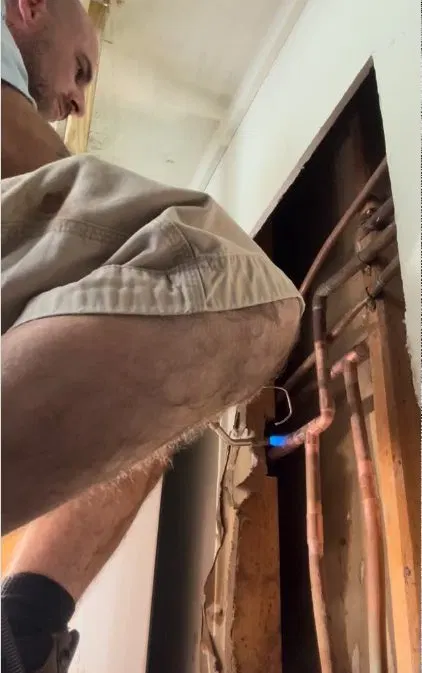
Work through them in that order before assuming anything expensive. If everything on that list checks out and the tank is still dropping, the fault is somewhere that needs instruments rather than observation, and that is the point at which professional locating earns its cost by finding it without opening up the property to look.
Why dry ground makes this harder than it sounds
In a wetter climate a buried leak eventually announces itself. The ground gets soggy, grass grows greener in a line, water finds a low point and pools. People notice.
Here, the ground absorbs a slow underground leak with very little to show for it, particularly in summer. A leak can run for months on a buried line and leave nothing at the surface a homeowner would spot on a walk round. That is why the indirect signals matter so much more than visual inspection.
There is one visual exception worth knowing. Vegetation is honest about water in a desert. A patch of ground that is noticeably greener, or a plant thriving where nothing else does, along the line of a known buried run is worth investigating. In a wet climate that signal is meaningless because everything is green. Here it stands out.
The same logic explains why root intrusion is such a persistent problem on drain and sewer lines around here. A slightly leaking joint is one of very few reliable water sources in dry ground, and roots will travel a long way to reach one. If you are seeing repeat blockages as well as a supply loss, looking inside the line often explains both at once.
What professional locating adds that you cannot do yourself
Everything above is diagnosis by elimination, and you can get a long way with it. What you cannot do without instruments is convert a narrowed-down area into a specific point.
The tools are straightforward in principle. Pressure testing isolated sections shows which run is losing. Acoustic listening picks up the sound of water escaping under pressure through soil or slab. Thermal imaging finds hot water leaks by the temperature signature they create at the surface before any moisture arrives. Line tracing establishes where a pipe actually runs, which on a custom-built property with unrecorded routing is often the missing piece.
The value of all that is negative rather than positive: it is what stops you digging. On a property with mature desert landscaping, established irrigation and hardscaping, the difference between one accurate excavation and three exploratory ones is usually far more than the cost of locating.
If the locating points under a slab, that becomes a different conversation about whether to repair the spot or abandon the run, and the condition of the surrounding pipe drives that decision more than the location does.
When to stop investigating and call
Working through this yourself is worthwhile, and plenty of these faults get found and fixed without a visit. There are points where it stops being sensible.
If the loss is fast enough to empty a tank overnight, stop investigating and isolate the supply. Rate matters more than cause at that point. If you cannot get the supply closed, or a shutoff will not hold, that is a call now regardless of the hour.
If water has reached an outlet, a panel or a light fitting, treat it as an electrical problem before a plumbing one and keep away from it. And if you have isolated the house, confirmed the tank still drops, and cannot find anything outdoors, the fault is in a place that needs instruments and continuing to look will only cost you water.
Common questions about leaks on unmetered properties
How much water can a running toilet actually waste?
Enough to matter on a stored supply. A flapper that no longer seals passes water continuously, and continuously adds up quickly against a tank rather than against a municipal main.
It is the single most common cause of unexplained consumption on these properties, and it is also the cheapest to fix. Check every toilet in the house, including a guest one that rarely gets used, because that is exactly where it goes unnoticed longest.
Can I test for a leak if I am on a well with no storage tank?
Yes, and the pump becomes your instrument. Close everything in the house, then watch whether the pump starts. A pump cycling with no draw means pressure is being lost somewhere.
Isolate the house at the main and repeat. If it still cycles, the loss is between the pump and that valve, which points at the pressure tank, the fittings or the buried run. If it stops, the loss is inside.
Does hard water actually cause leaks or just scale?
Both, and the second causes the first. Water reported in the mid to high teens in grains per gallon deposits mineral continuously inside pipe, and it does not deposit evenly.
Corrosion concentrates at the boundaries between scaled and bare metal, which is why copper here tends to fail as a sudden pinhole rather than gradual thinning you could anticipate. It is also why one pinhole is often followed by another, and why treating the water changes the trajectory for the rest of the system.
How long does professional leak locating take?
Often a couple of hours for a straightforward property, longer where runs are long, unrecorded or buried under hardscaping.
The variable is usually how much of the property has to be eliminated before the search narrows. Anything you have already ruled out yourself, particularly the isolation test, genuinely shortens it.
Is it worth locating if I am going to replace the pipe anyway?
Frequently yes, because locating tells you what you are replacing. Knowing whether the failure is at one point or whether the whole run is in similar condition is what decides between a repair, a reroute and replacing the run entirely.
It also establishes where the pipe actually runs, which matters on properties where the original routing was never recorded.
Could the problem be the delivery rather than my plumbing?
It is worth ruling out, and it is easy to check. Note the level before and after a delivery and compare it against what you ordered.
If deliveries are landing as expected and the tank still empties early, the loss is on your side. If the level after a delivery is consistently lower than it should be, that is a conversation with the supplier rather than a plumber.